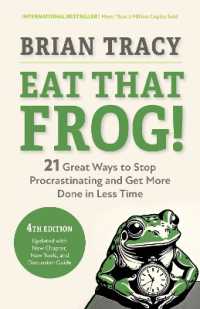
Eat That Frog!: 21 Great Ways to Stop Procrastinating and Get More Done in Less Time
Brian Tracy’s Eat That Frog! presents 21 practical strategies for overcoming procrastination and maximizing productivity. The book’s title comes from a Mark Twain quote: “Eat a live frog first thing in the morning, and nothing worse will happen to you the rest of the day.” Tracy uses this metaphor to illustrate the importance of tackling your most important and challenging task first thing in the morning.
The Central Premise: Tackle Your Biggest Challenge First
Tracy’s core argument is that success in any area of life is largely determined by how you manage your time and what you choose to do with it. He emphasizes that the ability to focus on and complete your most important task – your “frog” – is the key to achieving extraordinary results and reducing stress.
The book challenges the common tendency to avoid difficult or unpleasant tasks, showing that by confronting these challenges head-on, you can transform your productivity and success.
Part I: Understanding the Frog
What Is Your Frog?
Tracy defines your “frog” as your biggest, most important task – the one that, if completed, will have the greatest positive impact on your life or work. This is typically the task that you’re most likely to procrastinate on because it’s challenging, complex, or uncomfortable.
The Importance of the Frog
Tracy explains that your frog represents the 20% of activities that produce 80% of your results (the Pareto Principle). By identifying and completing your frog each day, you can achieve more in less time and with less stress.
Part II: The 21 Techniques
1. Set the Table
Before you can eat your frog, you need to know what it is. Tracy emphasizes the importance of setting clear goals and defining your desired outcomes in every area of your life.
2. Plan Every Day in Advance
Successful people plan their days in advance. Tracy recommends spending 10-12 minutes each morning (or the night before) planning your entire day, prioritizing tasks based on their importance and impact.
3. Apply the 80/20 Rule
The Pareto Principle states that 80% of your results come from 20% of your activities. Tracy teaches readers how to identify and focus on the vital few tasks that produce the majority of their results.
4. Consider the Consequences
Before starting any task, consider the positive and negative consequences of doing it well or poorly, or of not doing it at all. This helps you prioritize tasks based on their true importance.
5. Practice Creative Procrastination
Not all tasks are equally important. Tracy advocates for deliberately putting off less important tasks to make time for those that truly matter.
6. Use the ABCDE Method
Tracy presents a powerful prioritization technique:
- A tasks: Must do (serious consequences if not done)
- B tasks: Should do (mild consequences)
- C tasks: Nice to do (no consequences)
- D tasks: Delegate
- E tasks: Eliminate
Within each category, tasks can be numbered by priority (A-1, A-2, etc.).
7. Focus on Key Result Areas
Identify the key result areas in your work – the 5-7 activities that produce 90% of your results – and focus your efforts on excelling in these areas.
8. Apply the Law of Three
Tracy identifies three key forces that determine your success:
- The force of clarity (knowing your goals)
- The force of concentration (focusing on your goals)
- The force of force (taking action on your goals)
9. Prepare Thoroughly Before You Begin
Proper preparation is essential for successfully completing any important task. Tracy emphasizes the importance of gathering all necessary information and resources before starting your frog.
10. Take It One Oil Barrel at a Time
Break large, overwhelming tasks into smaller, manageable steps. Tracy uses the metaphor of an oil tanker that turns slowly but steadily, emphasizing that consistent small adjustments lead to major changes in direction.
11. Upgrade Your Key Skills
Continuously improve the skills that are most important to your success. Tracy recommends reading 30 minutes per day in your key areas to stay ahead.
12. Identify Your Key Constraints
Determine what is holding you back most in your work or life. Tracy teaches that focusing on removing your primary constraint can dramatically accelerate your progress.
13. Put the Pressure on Yourself
Create a sense of urgency around your important tasks. Tracy suggests setting deadlines and creating accountability to maintain momentum.
14. Motivate Yourself Into Action
Before tackling your frog, do something to build your energy and enthusiasm. This might include visualization, positive self-talk, or physical movement.
15. Get Up and Get Going
Take immediate action on your most important task. Tracy emphasizes that action builds momentum and motivation.
16. Slice and Dice the Task
Break large tasks into smaller components and tackle them one at a time. This makes overwhelming projects more manageable.
17. Create Large Chunks of Time
Protect blocks of uninterrupted time for your most important work. Tracy recommends scheduling 90-120 minute blocks for your frogs.
18. Develop a Sense of Urgency
Cultivate the habit of moving fast on your important tasks. Tracy argues that speed and decisiveness are key differentiators between successful and unsuccessful people.
19. Single-Handle Every Task
Focus on one task at a time until completion, rather than multitasking. Tracy explains that task switching reduces efficiency and increases errors.
20. Do It Twice (Do It Now, Do It Right)
Complete tasks correctly the first time rather than rushing through them and having to redo them later. Quality work reduces long-term stress.
21. Focus Your Attention
Maintain your focus on your most important task until completion. Tracy emphasizes that attention is like a spotlight – wherever you shine it grows brighter.
Key Concepts and Principles
The Power of Priority
Tracy emphasizes that success is not about doing more things, but about doing the right things. He teaches that focusing on high-value activities while eliminating low-value ones is the key to productivity.
The Importance of Action
A central theme in the book is that knowledge without action is worthless. Tracy emphasizes that success comes from taking consistent action toward goals rather than just learning about success principles.
The Role of Self-Discipline
Tracy identifies self-discipline as the foundation of all success. He teaches that the ability to delay gratification and consistently take action toward goals is what separates successful people from the rest.
Practical Applications
For Personal Productivity
- Identify your daily frog and tackle it first thing in the morning
- Use the ABCDE method to prioritize tasks
- Apply the 80/20 rule to focus on high-impact activities
- Create large chunks of uninterrupted time for important work
For Professional Success
- Focus on key result areas in your job
- Upgrade your skills continuously through daily learning
- Identify and remove constraints that limit your performance
- Develop a sense of urgency around important projects
For Goal Achievement
- Set clear, written goals in all areas of your life
- Plan each day in advance based on your goals
- Consider the consequences of your actions on goal achievement
- Take immediate action on goal-related tasks
Real-World Examples
Throughout the book, Tracy provides numerous examples of how these principles have helped people:
- Business executives who transformed their productivity by focusing on key result areas
- Entrepreneurs who achieved breakthrough success by consistently tackling their biggest challenges
- Professionals who reduced stress and increased income by applying the ABCDE method
- Students who improved their grades by identifying and completing their most important assignments first
The Impact of “Eat That Frog!”
Since its publication in 2001, Eat That Frog! has had a significant impact:
- It has sold millions of copies worldwide
- It has been translated into dozens of languages
- It has influenced how people think about time management and productivity
- It has been widely adopted in corporate training programs
Criticisms and Considerations
While widely praised, Tracy’s approach has faced some criticism:
- Some argue that the approach may oversimplify complex workplace dynamics
- Others question whether the philosophy applies equally across all job types and industries
- The focus on individual productivity may overlook systemic factors that affect performance
Conclusion
Eat That Frog! provides a practical framework for overcoming procrastination and maximizing productivity. Tracy’s insights help readers:
- Identify their most important tasks and tackle them first
- Develop effective prioritization systems
- Build self-discipline and consistent action habits
- Achieve better results with less stress
The book’s enduring popularity reflects a widespread need for practical guidance on time management and productivity. Tracy’s direct approach and actionable strategies make the principles immediately applicable.
Whether you’re a busy professional, an entrepreneur, a student, or anyone seeking to improve their productivity, Eat That Frog! provides valuable tools for achieving your goals.
Tracy’s central message is empowering: by tackling your biggest challenge first each day, you can transform your productivity and success. The key is not to avoid the frog but to eat it first thing in the morning.
The book ultimately encourages readers to stop procrastinating on their most important work and start taking immediate action. It’s a call to action that recognizes that the path to success is through consistent, focused effort on what truly matters.