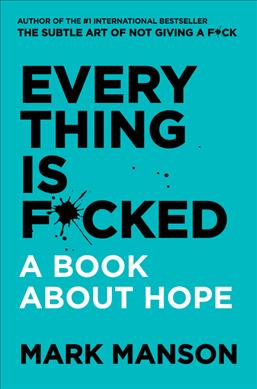
Everything Is F*cked: A Book About Hope
In Everything Is Fcked*, Mark Manson explores the nature of hope and how to maintain it in an increasingly chaotic world. Building on the success of his previous book, Manson delves into how we can find meaning and maintain hope without deluding ourselves about reality.
Introduction: The Paradox of Hope
Manson begins by addressing the paradox that gives the book its title: everything truly is f*cked, yet we must still find ways to maintain hope. He argues that the modern world presents us with unprecedented challenges while simultaneously overwhelming us with information and choices that often increase our anxiety rather than alleviate it.
He distinguishes his approach from both naive optimism and nihilistic pessimism, proposing a middle path that acknowledges the difficulties of life while still finding reasons to continue striving for meaning and connection.
Part 1: The Crisis of Hope
The Collapse of Traditional Belief Systems
Manson explores how traditional sources of hope and meaning have been eroded in modern society:
- The decline of religious faith in many Western societies
- The failure of political systems to address major challenges
- The loss of trust in institutions and authority figures
- The fragmentation of communities and shared values
He examines how these changes have left many people feeling adrift and uncertain about what to believe in or hope for.
The Information Age and Its Discontents
The book addresses how the information age has paradoxically made it harder to maintain hope:
- The constant stream of bad news from around the world
- The difficulty of distinguishing reliable information from propaganda
- The way social media creates unrealistic comparisons
- The erosion of expertise and shared facts
Manson argues that while we have more information than ever before, we often lack the wisdom to process it effectively.
The Psychology of Despair
Manson delves into the psychological mechanisms that lead to despair:
- The role of uncertainty and lack of control
- How meaninglessness contributes to depression
- The impact of social isolation on mental health
- The way consumer culture can increase rather than decrease dissatisfaction
He draws on psychological research and philosophical insights to explain why so many people struggle with hope in the modern world.
Part 2: Understanding Hope
What Hope Actually Is
Manson challenges conventional notions of hope, arguing that it’s not simply positive thinking or wishful fantasy. Instead, he defines hope as:
- A realistic assessment of difficulties combined with a commitment to action
- A form of resilience that allows us to persist despite setbacks
- A recognition that while we can’t control everything, we can control some things
- A form of faith in our own ability to adapt and grow
He emphasizes that true hope requires both courage and humility.
False Hopes and Delusions
The book distinguishes between genuine hope and various forms of delusion:
- Magical thinking that ignores real constraints
- Denial of serious problems
- Overconfidence in simple solutions to complex issues
- The pursuit of happiness as an end in itself
Manson argues that false hopes ultimately lead to greater disappointment and despair.
The Role of Uncertainty
Manson explores how to maintain hope in the face of uncertainty:
- Accepting that we can’t predict or control everything
- Finding meaning in the process rather than just the outcome
- Developing resilience for dealing with unexpected challenges
- Learning to make decisions with incomplete information
He suggests that learning to be comfortable with uncertainty is crucial for maintaining realistic hope.
Part 3: Sources of Hope
Community and Connection
One of Manson’s key insights is that hope is fundamentally social:
- The importance of belonging to communities with shared values
- How relationships provide meaning and support
- The role of collective action in creating change
- The way shared struggles can bring people together
He argues that individualistic approaches to hope often fail because humans are fundamentally social beings who need connection to thrive.
Values and Meaning
Manson explores how values and meaning provide a foundation for hope:
- Identifying and living by core values
- Finding causes larger than ourselves to work toward
- Creating meaning through our choices and actions
- The relationship between meaning and resilience
He emphasizes that meaning is something we create rather than something we find.
Progress and Growth
The book examines how a realistic understanding of progress can sustain hope:
- Recognizing that change is often slow and incremental
- Celebrating small wins along the way to larger goals
- Learning from failures rather than being defeated by them
- The importance of personal growth and development
Manson argues that focusing on the process of improvement rather than immediate results leads to more sustainable hope.
Part 4: The Mechanics of Hope
Building Hopeful Habits
Manson provides practical advice for building habits that support hope:
- Daily practices that reinforce values and meaning
- Ways to maintain connection with others
- Techniques for managing anxiety and uncertainty
- Strategies for staying engaged with difficult problems
He emphasizes that hope is not a feeling that happens to us but a practice we engage in.
Managing Expectations
The book discusses how to manage expectations in ways that support hope:
- Setting realistic goals and timelines
- Accepting that setbacks are normal
- Focusing on effort rather than outcomes
- Learning to be satisfied with progress rather than perfection
Manson argues that unrealistic expectations are a major obstacle to sustained hope.
Dealing with Setbacks
Manson explores how to maintain hope when facing setbacks:
- Reframing failures as learning opportunities
- Maintaining perspective on long-term goals
- Seeking support from others during difficult times
- Adjusting strategies without giving up entirely
He emphasizes that resilience in the face of setbacks is crucial for maintaining hope.
Part 5: Hope in Action
Political and Social Hope
Manson addresses how to maintain hope in the political and social realm:
- The importance of civic engagement
- How to work for change without becoming cynical
- The role of compromise and pragmatism
- Building coalitions around shared values
He argues that political despair often stems from unrealistic expectations rather than genuine impossibility.
Environmental Hope
The book explores how to maintain hope in the face of environmental challenges:
- The importance of focusing on solutions rather than just problems
- How individual actions can contribute to larger change
- The role of innovation and technology
- Maintaining perspective on the scale of change needed
Manson acknowledges the seriousness of environmental challenges while arguing that despair is not a productive response.
Personal Hope
Manson addresses how to maintain hope in our personal lives:
- Building and maintaining relationships
- Finding meaning in work and daily activities
- Managing personal challenges and setbacks
- Creating a sense of purpose and direction
He emphasizes that personal hope is foundational to all other forms of hope.
Part 6: The Future of Hope
Adapting to Change
Manson explores how to maintain hope in a rapidly changing world:
- The importance of adaptability and resilience
- Learning to navigate uncertainty
- Finding stability in values rather than circumstances
- The role of lifelong learning and growth
He argues that learning to adapt is crucial for maintaining hope in an uncertain future.
Technology and Hope
The book addresses how technology affects our capacity for hope:
- The potential benefits and drawbacks of technological change
- How to use technology in ways that support rather than undermine hope
- The importance of maintaining human connection in a digital age
- The need for ethical considerations in technological development
Intergenerational Hope
Manson explores how to maintain hope across generations:
- The responsibility we have to future generations
- How to prepare young people for challenges ahead
- The importance of preserving knowledge and wisdom
- Building systems that can sustain hope over time
Key Principles
1. Hope Requires Realism
Manson’s central message is that genuine hope requires facing reality rather than escaping from it. He argues that false hopes ultimately lead to greater disappointment and despair.
2. Hope is Social
He emphasizes that hope is fundamentally a social phenomenon that requires connection with others and shared values.
3. Hope is a Practice
Manson argues that hope is not a feeling that happens to us but a practice we must engage in through our choices and actions.
4. Hope Requires Values
He emphasizes that hope must be grounded in values and meaning rather than mere positive thinking.
5. Hope Requires Resilience
Manson argues that maintaining hope requires developing resilience to deal with setbacks and disappointments.
Addressing Criticisms
The Risk of Pessimism
Manson acknowledges that his approach might seem pessimistic to some readers:
- He distinguishes between realistic assessment and defeatism
- He argues that acknowledging difficulties is necessary for effective action
- He emphasizes that hope can coexist with a clear-eyed view of problems
Individual vs. Systemic Change
He addresses the tension between individual responsibility and systemic problems:
- He acknowledges that some problems require collective action
- He argues that individual change can contribute to larger transformation
- He emphasizes the importance of both personal and political engagement
Practical Applications
For Mental Health
Manson discusses how his approach can support mental health:
- The importance of realistic expectations
- How values and meaning can provide stability
- The role of community in mental wellness
- Techniques for managing anxiety about the future
For Relationships
The book explores how hope affects relationships:
- The importance of shared values and goals
- How to support others through difficult times
- The role of honesty and vulnerability in connection
- Building communities based on mutual support
For Work and Career
Manson addresses how to maintain hope in professional contexts:
- Finding meaning in work even when it’s challenging
- Managing career setbacks and disappointments
- The importance of continuous learning and growth
- Building professional communities and networks
Conclusion: Choosing Hope
In his conclusion, Manson emphasizes that hope is ultimately a choice:
- The decision to engage with difficulties rather than avoid them
- The commitment to values and meaning despite uncertainty
- The willingness to persist in the face of setbacks
- The recognition that hope is not a guarantee but a stance toward life
He reminds readers that while everything may be f*cked in some ways, we still have the capacity to create meaning and maintain hope through our choices and actions.
Impact and Legacy
Everything Is Fcked* represents a significant contribution to the conversation about hope and meaning in the modern world. Building on the success of The Subtle Art of Not Giving a Fck*, Manson deepens his exploration of how to live a meaningful life despite the challenges we face.
The book’s impact extends beyond individual readers to broader cultural conversations about mental health, political engagement, and social responsibility. It has contributed to a more nuanced understanding of hope that acknowledges both the difficulties of modern life and our capacity to respond to them effectively.
Through this work, Manson has established himself as a thoughtful and provocative voice in personal development, offering insights that are both realistic and hopeful. His approach of combining brutal honesty with practical wisdom has resonated with readers who are seeking ways to maintain hope in an increasingly complex world.