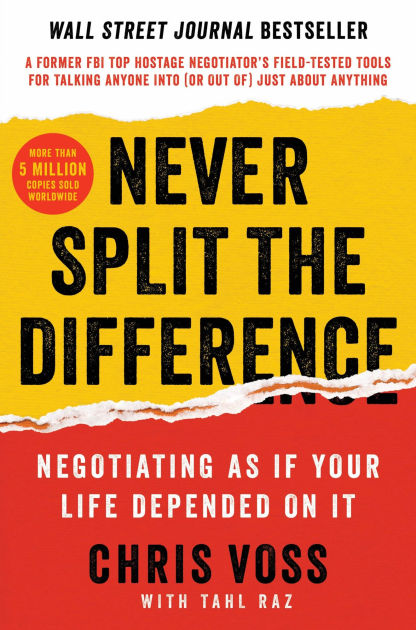
Never Split the Difference: Negotiating As If Your Life Depended On It
Chris Voss’s Never Split the Difference reveals the nine powerful principles that helped him become the FBI’s lead international kidnapping negotiator. Drawing on his experience in high-stakes situations, Voss shows how to apply these techniques to any negotiation, from salary discussions to business deals to everyday conversations.
The Central Premise: Negotiation Is About Emotions, Not Logic
Voss’s core argument is that traditional negotiation approaches (like the “split the difference” method) are ineffective. Instead, he advocates for:
- Understanding the other side’s emotions and motivations
- Using specific verbal techniques to influence outcomes
- Focusing on collaboration rather than competition
- Recognizing that negotiation is about communication, not logic
The book challenges conventional wisdom about negotiation by emphasizing emotional intelligence and tactical empathy over traditional bargaining tactics.
Part I: The Three Types of Negotiators
The Three Negotiator Archetypes
Voss identifies three distinct types of negotiators, each requiring a different approach:
1. Analysts
- Methodical and detail-oriented
- Need data and time to process information
- Can become overwhelmed by too much information at once
- Require clear, logical arguments
2. Accommodators
- Relationship-focused and collaborative
- Want to be liked and avoid conflict
- May sacrifice their own interests to maintain harmony
- Respond well to personal connection and empathy
3. Assertives
- Direct and results-oriented
- Want to win and control the conversation
- May be impatient with lengthy discussions
- Respect strength and confidence
Adapting Your Approach
Understanding these types allows you to:
- Adjust your communication style to match theirs
- Anticipate their concerns and objections
- Use techniques that resonate with their personality
- Build rapport more effectively
Part II: The Nine Powerful Principles
1. Use Tactical Empathy
Tactical empathy is understanding where the other side is coming from, but also influencing where they’re going. This involves:
- Understanding what the other side is feeling
- Influencing their emotional state
- Creating a connection that leads to cooperation
- Going beyond sympathy to active emotional influence
Key Techniques
- Mirroring: Repeating the last few words someone said to encourage them to elaborate
- Labeling: Identifying and acknowledging emotions to defuse tension
- Accusation Audit: Addressing potential objections before the other side raises them
2. Become a Mirror
Mirroring is one of the most powerful tools in Voss’s arsenal. It involves:
- Repeating the last three words (or critical words) of what someone said
- Doing it in an inquisitive tone
- Waiting for them to elaborate
- Using it to build rapport and gain information
Benefits of Mirroring
- Encourages the other side to talk more
- Shows you’re listening actively
- Helps you gather more information
- Creates a sense of connection and understanding
3. Don’t Fear the “No”
Voss argues that “no” is not a rejection but a tool for negotiation:
- “No” often means “I’m not comfortable with that”
- “No” provides valuable information about boundaries
- “No” gives the other side a sense of control
- “No” is often a step toward “yes”
Strategic Use of “No”
- Ask questions that may result in “no” to gather information
- Don’t be afraid to hear “no” from the other side
- Use “no” to clarify boundaries and priorities
- Recognize that “no” can lead to better alternatives
4. Use “That’s Right”
“That’s right” is more powerful than “yes” because:
- It shows deep understanding of the other side’s perspective
- It validates their feelings and concerns
- It demonstrates that you’ve been listening
- It creates a sense of alignment and agreement
How to Get “That’s Right”
- Listen carefully to understand their underlying concerns
- Summarize their perspective accurately
- Show empathy for their situation
- Frame your response in a way that acknowledges their viewpoint
5. Master the Art of Calibration
Calibrated questions are open-ended questions that start with “how” or “what” and guide the conversation:
- “How am I supposed to do that?”
- “What are we trying to accomplish here?”
- “How can we make this work for both sides?”
Benefits of Calibrated Questions
- They prevent you from making assumptions
- They guide the conversation in your desired direction
- They make the other side feel like they’re in control
- They gather information without revealing your position
6. Create the Illusion of Control
People are more likely to agree when they feel they have control over the decision:
- Give them choices rather than directives
- Use calibrated questions to guide them to your preferred outcome
- Let them feel like they came up with the solution
- Acknowledge their expertise and input
Techniques for Creating Control
- Offer multiple options that all serve your interests
- Ask for their advice on how to solve problems
- Frame decisions as collaborative rather than confrontational
- Recognize their contributions to the process
7. Guarantee Execution
Getting agreement is only half the battle; ensuring follow-through is equally important:
- Get the same agreement three times using different words
- Address implementation details upfront
- Identify potential obstacles and solutions
- Confirm commitment and next steps
The Rule of Three
- First agreement: Initial commitment
- Second agreement: Restatement with different words
- Third agreement: Implementation details and timeline
8. Use the Ackerman Model
The Ackerman Model is a bidding system that replaces traditional haggling:
- Set your target price
- Make your first offer at 65% of your target
- Make your second offer at 85% of your target
- Make your final offer at 95-99% of your target
- Use calibrated questions throughout the process
Benefits of the Ackerman Model
- It’s based on psychological research about how people respond to offers
- It prevents you from giving up too much too quickly
- It creates momentum toward your target
- It makes the other side feel like they’re winning
9. Be Prepared to Go to “No”
Sometimes the best outcome is to walk away:
- Know your minimum acceptable terms upfront
- Don’t be afraid to say “no” to bad deals
- Recognize when the other side isn’t negotiating in good faith
- Understand that walking away preserves your power
Part III: Advanced Tactics
Black Swan Moments
Voss introduces the concept of “black swan” moments—pieces of information that can completely change the negotiation:
- They’re unexpected pieces of information
- They reveal hidden motivations or constraints
- They can unlock previously impossible solutions
- They require careful listening to discover
How to Find Black Swans
- Listen for information that contradicts assumptions
- Ask calibrated questions that reveal hidden constraints
- Pay attention to emotional reactions and body language
- Look for inconsistencies in the other side’s story
The Power of “How”
“How” questions are particularly powerful because:
- They force the other side to think about solutions
- They make them feel like they’re in control
- They prevent them from making excuses
- They gather information about capabilities and constraints
Strategic “How” Questions
- “How am I supposed to do that?” (when they make a demand)
- “How can we make this work?” (when facing obstacles)
- “How does this fit with everything else you’re doing?” (to understand priorities)
- “How would you like to proceed?” (to guide decision-making)
Key Concepts and Principles
Tactical Empathy vs. Sympathy
Voss distinguishes between sympathy and tactical empathy:
- Sympathy: Feeling sorry for someone else’s situation
- Tactical Empathy: Understanding their perspective to influence outcomes
Tactical empathy is a tool for negotiation, not just an emotional response.
The Importance of Calm
In negotiation, staying calm is more important than being right:
- The person who stays calmest has the most power
- Emotions can derail even the best logical arguments
- Calm creates space for creative solutions
- Calm demonstrates confidence and control
The Myth of “Win-Win”
Voss challenges the popular “win-win” approach:
- Most negotiations are not truly win-win
- Focusing on win-win can prevent you from getting what you need
- Better outcomes come from understanding what each side really wants
- Collaboration is more effective than compromise
Practical Applications
For Salary Negotiations
- Research market rates and your value proposition
- Use calibrated questions to understand their constraints
- Label their concerns to show empathy
- Present multiple options that all benefit you
For Business Deals
- Identify the key decision-makers and their motivations
- Use tactical empathy to understand their priorities
- Create the illusion of control through choices
- Guarantee execution with clear next steps
For Personal Relationships
- Listen actively to understand underlying concerns
- Use mirroring to encourage deeper conversation
- Label emotions to defuse tension
- Focus on collaboration rather than winning arguments
For Sales and Customer Service
- Understand customer pain points and motivations
- Use calibrated questions to guide them to solutions
- Create the illusion of control through choices
- Guarantee satisfaction with clear follow-through
Real-World Examples
Throughout the book, Voss shares compelling examples from his FBI career:
- Hostage Negotiations: How tactical empathy saved lives
- Kidnapping Cases: How understanding motivations led to peaceful resolutions
- Business Deals: How his techniques helped companies achieve better outcomes
- Everyday Situations: How these principles apply to salary negotiations, car purchases, and family discussions
The Impact of “Never Split the Difference”
Since its publication in 2016, the book has had a significant impact:
- It became a #1 New York Times bestseller
- It has been translated into dozens of languages
- It has influenced how people approach negotiation in business and personal life
- It has spawned training programs and courses based on Voss’s techniques
Criticisms and Considerations
While widely praised, Voss’s approach has faced some criticism:
- Some argue that his techniques can be manipulative if used unethically
- Others question whether his FBI experience translates perfectly to business negotiations
- The focus on emotional manipulation may not work in all cultural contexts
- Some find his techniques too formulaic for complex negotiations
Conclusion
Never Split the Difference provides a practical guide to negotiation based on real-world experience in high-stakes situations. Voss’s insights help readers:
- Understand that negotiation is about emotions, not just logic
- Use specific verbal techniques to influence outcomes
- Focus on collaboration rather than competition
- Apply these principles to any negotiation, from salary discussions to business deals
The book’s enduring popularity reflects a widespread need for practical guidance on how to negotiate effectively in both professional and personal contexts. Voss’s combination of real-world experience and psychological insights makes the principles accessible and actionable.
Whether you’re negotiating a salary, closing a business deal, or resolving a family dispute, Never Split the Difference provides valuable tools for achieving better outcomes through tactical empathy and emotional intelligence.
Voss’s central message is empowering: you don’t need to be the smartest person in the room to negotiate effectively. By understanding emotions, using specific verbal techniques, and staying calm under pressure, you can achieve better outcomes in any negotiation.
The book ultimately encourages readers to approach negotiation as a form of communication rather than confrontation, to listen more than they talk, and to seek understanding before seeking agreement.