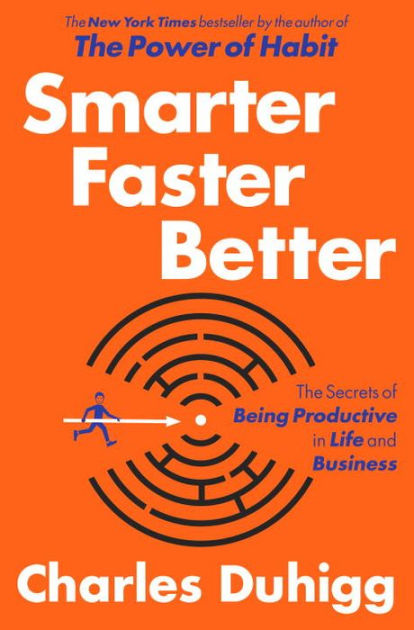
Smarter Faster Better: The Secrets of Being Productive in Life and Business
Charles Duhigg’s Smarter Faster Better explores the science of productivity, revealing why some people and organizations accomplish so much while others struggle with the same amount of time and resources. Building on the success of The Power of Habit, Duhigg delves into the psychology and neuroscience behind productive behavior, offering eight key concepts that can transform how we work and live.
The Central Premise: Productivity as a Skill
Duhigg’s core argument is that productivity isn’t about working harder or faster, but about working smarter. He contends that productivity is a skill that can be learned and developed, just like any other ability. The most productive people and organizations don’t necessarily work more hours or with greater intensity; they’ve figured out how to make their choices more intentional and their efforts more focused.
The Eight Key Concepts
1. Motivation: Finding Purpose in Our Work
Productivity isn’t just about efficiency—it’s about finding genuine motivation in what we do. Duhigg explains that people are most productive when they believe their work has meaning and that they have some control over how they approach their tasks. This sense of agency and purpose creates a powerful motivational engine that drives sustained effort and innovation.
2. Teams: Psychological Safety and Smart Storming
The most effective teams are those where members feel safe to take risks and express ideas without fear of judgment. Duhigg introduces the concept of “smart storming,” where teams deliberately create environments that encourage disagreement and debate while maintaining psychological safety. This approach leads to better decision-making and more creative solutions.
3. Focus: Managing Attention in an Age of Distraction
In our hyperconnected world, the ability to focus deeply has become a rare and valuable skill. Duhigg explores how successful people manage their attention, explaining that productivity comes not from multitasking but from the deliberate choice of what to focus on and when. He discusses techniques for maintaining focus and the importance of selective attention.
4. Goal Setting: Stretching Beyond Our Comfort Zone
Effective goal setting involves creating objectives that are challenging yet achievable. Duhigg explains the science behind “stretch goals” that push people beyond their comfort zones while remaining realistic enough to maintain motivation. He shows how the right goals can unlock hidden potential and drive extraordinary performance.
5. Managing Others: The Power of Choice
The best leaders give their team members meaningful choices in how they approach their work. This approach increases engagement and productivity by giving people a sense of control and ownership over their tasks. Duhigg explores how providing autonomy within clear boundaries leads to better outcomes.
6. Decision Making: Embracing Uncertainty
Productive decision-making involves embracing uncertainty rather than trying to eliminate it. Duhigg explains how successful people and organizations make better decisions by acknowledging what they don’t know, seeking diverse perspectives, and creating systems that allow for quick course corrections when new information emerges.
7. Innovation: The Importance of Creative Struggle
True innovation comes from productive struggle—the process of wrestling with difficult problems and exploring multiple solutions. Duhigg shows how the most creative organizations build systems that encourage experimentation and learning from failure, rather than trying to avoid challenges.
8. Absorbing Data: Developing Mental Models
In an age of information overload, the key to productivity is developing mental models that help us process and make sense of data quickly. Duhigg explains how experts in various fields build sophisticated mental models that allow them to make rapid, accurate decisions with incomplete information.
Real-World Applications
Individual Productivity
Duhigg provides practical guidance for individuals looking to improve their productivity:
- Finding meaning and purpose in daily tasks
- Developing systems for managing attention and focus
- Setting goals that are both challenging and achievable
- Building mental models for processing information efficiently
Team and Organizational Productivity
The book offers insights for leaders and managers:
- Creating psychologically safe environments for teams
- Providing meaningful choices to team members
- Encouraging productive struggle and experimentation
- Building systems for better decision-making
Corporate Applications
Duhigg explores how major companies have applied these principles:
- How Google created psychologically safe teams
- How Intuit transformed its innovation process
- How the U.S. military improved decision-making under pressure
- How Disney developed creative processes that balance structure and freedom
Part I: The Individual
The Motivation Equation
Duhigg begins by exploring how motivation works, explaining that people are most productive when they feel a sense of agency and believe their work has meaning. He discusses the difference between intrinsic and extrinsic motivation and how to cultivate the former.
The Focus Imperative
In an age of constant distraction, the ability to focus deeply has become increasingly valuable. Duhigg explores how successful people manage their attention and provides strategies for maintaining focus in demanding environments.
The Goal-Setting Science
Duhigg delves into the research on goal setting, explaining why some objectives motivate while others demoralize. He discusses the importance of stretch goals and how to set targets that drive performance without causing burnout.
Part II: The Group
Building Better Teams
Duhigg examines what makes teams effective, focusing on psychological safety and the importance of creating environments where people feel safe to take risks and express ideas. He discusses how to foster productive disagreement while maintaining team cohesion.
Leading Through Choice
The best leaders don’t try to control every aspect of their team’s work. Instead, they provide clear direction while giving team members meaningful choices in how they approach their tasks. Duhigg explores how this approach increases engagement and productivity.
Decision Making Under Uncertainty
In today’s fast-changing world, the ability to make good decisions with incomplete information is crucial. Duhigg explains how successful organizations build systems that allow for rapid decision-making while remaining flexible enough to adapt as new information emerges.
Part III: The Organization
Fostering Innovation
Duhigg explores how organizations can create systems that encourage innovation, focusing on the importance of productive struggle and learning from failure. He discusses how to balance structure and freedom in creative processes.
Processing Information Efficiently
In an age of information overload, the key to organizational productivity is developing systems for processing and making sense of data quickly. Duhigg explains how experts build mental models that allow them to make rapid, accurate decisions.
Key Concepts and Principles
Productivity as a Skill
Duhigg emphasizes that productivity is not a trait but a skill that can be developed through practice and deliberate effort. This perspective empowers people to improve their performance regardless of their natural abilities or circumstances.
The Importance of Choice
Providing people with meaningful choices increases their engagement and productivity by giving them a sense of control and ownership over their work. This principle applies at both individual and organizational levels.
Embracing Uncertainty
Rather than trying to eliminate uncertainty, productive people and organizations learn to embrace it as a source of opportunity and innovation. This approach leads to better decision-making and more adaptive responses to change.
Practical Applications
For Individuals
- Find meaning and purpose in daily tasks to increase motivation
- Develop systems for managing attention and maintaining focus
- Set stretch goals that challenge but don’t overwhelm
- Build mental models for processing information efficiently
- Seek out environments that provide psychological safety and meaningful choices
For Teams and Leaders
- Create psychologically safe environments that encourage risk-taking
- Provide team members with meaningful choices in how they approach work
- Foster productive disagreement and debate
- Build systems for rapid decision-making under uncertainty
- Encourage experimentation and learning from failure
For Organizations
- Develop processes that balance structure and creative freedom
- Create systems for processing information efficiently
- Build cultures that value both individual agency and collective effort
- Implement feedback mechanisms that allow for rapid course corrections
- Design work environments that support deep focus and sustained attention
The Impact of “Smarter Faster Better”
Since its publication in 2016, Smarter Faster Better has influenced how people think about productivity:
- It’s been widely adopted in business and management education
- Companies have used its principles to redesign work processes and team structures
- It’s been translated into multiple languages and has sold hundreds of thousands of copies
- It’s influenced the broader conversation about workplace productivity and employee engagement
Criticisms and Considerations
While widely praised, Duhigg’s approach has faced some criticism:
- Some argue that the book’s emphasis on individual productivity may overlook systemic factors that affect performance
- Others question whether all of the concepts are equally applicable across different cultures and contexts
- The focus on corporate examples may not fully address the challenges faced by individuals outside of organizational settings
Conclusion
Smarter Faster Better provides a comprehensive framework for understanding and improving productivity. Duhigg’s insights help readers:
- Recognize that productivity is a skill that can be developed
- Understand the psychological factors that drive performance
- Apply evidence-based principles to improve their work and lives
- Create environments that support sustained productivity and innovation
The book’s enduring popularity reflects a widespread need for guidance on how to be more effective in an increasingly complex and demanding world. Duhigg’s combination of scientific research, real-world examples, and practical advice makes complex concepts accessible and actionable.
Whether you’re an individual looking to improve your personal productivity, a leader seeking to build more effective teams, or an organization trying to enhance performance, Smarter Faster Better provides valuable tools for achieving your goals.
Duhigg’s central message is empowering: productivity isn’t about working harder or faster, but about making smarter choices about how we direct our time and energy. By understanding the science behind productive behavior, we can transform how we work and live, accomplishing more with the same amount of effort.
The book ultimately encourages readers to stop trying to do everything and start focusing on doing the right things well. It’s a call to action that recognizes the reality of modern demands while providing a clear path toward greater effectiveness and satisfaction.