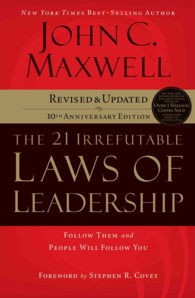
The 21 Irrefutable Laws of Leadership: Follow Them and People Will Follow You
John C. Maxwell’s seminal work, The 21 Irrefutable Laws of Leadership, provides a comprehensive framework for understanding and applying the timeless principles of effective leadership. Drawing from decades of experience, Maxwell presents each law with clarity, practical examples, and actionable insights, making it an indispensable guide for aspiring and seasoned leaders alike.
Introduction: The Foundation of Leadership
Maxwell begins by establishing that leadership is influence—nothing more, nothing less. He challenges the common misconception that leadership is about position, rank, or title. Instead, he argues that true leadership is about the ability to influence others toward a shared goal or vision.
He emphasizes that leadership is not reserved for the elite few but is a learnable skill that anyone can develop. The 21 laws presented in the book are not theoretical concepts but practical principles that have been tested and proven across various contexts and throughout history.
The 21 Irrefutable Laws of Leadership
1. The Law of the Lid
Leadership ability determines a person’s level of effectiveness. This foundational law states that leadership ability determines a person’s level of effectiveness. The lower an individual’s ability to lead, the lower the lid on their potential. To increase effectiveness, one must raise their leadership lid.
2. The Law of Influence
The true measure of leadership is influence—nothing more, nothing less. True leadership is not about position, title, or seniority; it’s about influence. Maxwell asserts that if you can’t influence people, they won’t follow you, regardless of your official role. Influence is earned through character, competence, and connection.
3. The Law of Process
Leadership develops daily, not in a day. Leadership is not an event but a continuous journey. The Law of Process emphasizes that leadership develops daily, not in a day. It requires consistent effort, learning, and growth over time.
4. The Law of Navigation
Anyone can steer the ship, but it takes a leader to chart the course. Any person can steer the ship, but it takes a leader to chart the course. The Law of Navigation highlights the leader’s role in planning, strategizing, and guiding their team through challenges to reach their destination.
5. The Law of Addition
Leaders add value to others by serving them. Leaders add value to others by serving them. This law underscores the importance of selfless leadership, where the leader’s primary focus is on empowering and uplifting those they lead.
6. The Law of Solid Ground
Trust is the foundation of leadership. Trust is the foundation of leadership. The Law of Solid Ground asserts that trust is built on competence, connection, and character. Without trust, a leader’s influence crumbles.
7. The Law of the Inner Circle
A leader’s potential is determined by those closest to him. A leader’s potential is directly proportional to the strength of their inner circle. This law emphasizes the importance of surrounding oneself with a strong, capable, and supportive team.
8. The Law of Empowerment
Only secure leaders give power to others. Only secure leaders give power to others. The Law of Empowerment teaches that true leaders empower their followers, fostering growth and initiative, rather than hoarding power out of insecurity.
9. The Law of the Picture
People do what people see. People do what people see. The Law of the Picture highlights the importance of leading by example. Leaders must model the behavior and values they wish to see in their team.
10. The Law of Buy-In
People buy into the leader, then the vision. People buy into the leader, then the vision. This law explains that followers first commit to the leader’s character and credibility before embracing their vision or mission.
11. The Law of Victory
Leaders find a way for the team to win. Leaders find a way for the team to win. The Law of Victory emphasizes that effective leaders are focused on victory and create an environment where success is possible and expected.
12. The Law of the Big Mo
Momentum is a leader’s best friend. Momentum is a leader’s best friend. The Law of the Big Mo explains how momentum can make a leader’s job easier and more effective, while lack of momentum can make it nearly impossible.
13. The Law of Priorities
Leaders understand that activity is not necessarily accomplishment. Leaders understand that activity is not necessarily accomplishment. The Law of Priorities emphasizes the importance of focusing on what’s most important rather than what’s most urgent.
14. The Law of Sacrifice
A leader must give up to go up. A leader must give up to go up. The Law of Sacrifice highlights that leadership often requires personal sacrifice, including time, energy, and comfort.
15. The Law of Timing
Leaders must wait for the right moment to act. Leaders must wait for the right moment to act. The Law of Timing emphasizes that timing can make or break a leader’s efforts and that patience is often as important as action.
16. The Law of Explosion
Leaders multiply themselves by developing others. Leaders multiply themselves by developing others. The Law of Explosion shows how effective leaders develop other leaders, creating a multiplying effect rather than an additive one.
17. The Law of Connection
Leaders touch hearts before they ask for hands. Leaders touch hearts before they ask for hands. The Law of Connection emphasizes that people want to be understood and cared for before they care about a leader’s vision or agenda.
18. The Law of the Inner Circle
A leader’s potential is determined by those closest to him. (Note: This is the same as Law #7, but with a different emphasis on the importance of the inner circle’s influence on a leader’s growth and effectiveness.)
19. The Law of Reproduction
It takes a leader to raise up a leader. It takes a leader to raise up a leader. The Law of Reproduction emphasizes that leadership is developed best through mentorship and hands-on experience with other leaders.
20. The Law of Contribution
A leader’s legacy is measured by succession. A leader’s legacy is measured by succession. The Law of Contribution emphasizes that true leaders focus on what they can give rather than what they can get, and their ultimate contribution is developing future leaders.
21. The Law of Legacy
A leader’s lasting value is measured by succession. A leader’s lasting value is measured by succession. The Law of Legacy emphasizes that the true measure of a leader is not what they accomplish during their tenure but what they leave behind in the form of developed leaders and lasting impact.
How the Laws Work Together
Maxwell explains that these laws are not meant to be understood in isolation but as interconnected principles that reinforce and support each other. For example:
- The Law of the Lid affects all other laws because leadership ability determines how effectively one can apply any of the other principles
- The Law of Process shows that developing leadership according to all these laws is a lifelong journey
- The Law of Addition and the Law of Empowerment work together to show how leaders create value for others
- The Law of Navigation and the Law of Priorities work together to help leaders chart and follow the right course
Practical Applications
Maxwell provides numerous real-world examples and case studies to illustrate how these laws work in practice:
- Historical figures like George Washington, Abraham Lincoln, and Winston Churchill
- Business leaders like Lee Iacocca and Jack Welch
- Sports coaches and team leaders
- Community organizers and non-profit leaders
Personal Leadership Development
The book emphasizes that leadership development is a personal journey:
- Self-assessment of current leadership abilities
- Identification of areas for growth
- Commitment to daily improvement
- Practice of leadership principles in everyday situations
- Mentorship and learning from other leaders
Common Leadership Mistakes
Maxwell also addresses common mistakes that leaders make:
- Focusing on position rather than influence
- Neglecting personal growth and development
- Failing to develop others
- Not building trust with their team
- Ignoring the importance of timing
- Trying to do everything themselves rather than empowering others
The Impact of Effective Leadership
The book explores the positive impact that effective leadership can have:
- On individuals and their personal growth
- On teams and their performance
- On organizations and their success
- On communities and their development
- On society and its progress
Conclusion: The Journey to Leadership Excellence
Maxwell concludes by emphasizing that leadership is not a destination but a journey. The 21 laws provide a roadmap for that journey, but the traveler must commit to continuous learning, growth, and application of these principles.
He reminds readers that leadership is not about perfection but about progress. Every leader, regardless of their current level of effectiveness, can grow and develop by understanding and applying these laws.
The 21 Irrefutable Laws of Leadership serves as both a reference guide and an inspirational call to action for anyone seeking to become a more effective leader. By understanding and applying these timeless principles, individuals can cultivate the qualities necessary to influence others, build strong teams, and achieve significant results.
The book’s enduring popularity reflects its practical value and the universal need for effective leadership. Maxwell’s clear, accessible writing style and abundant real-world examples make these principles immediately applicable to readers from all walks of life and levels of leadership experience.