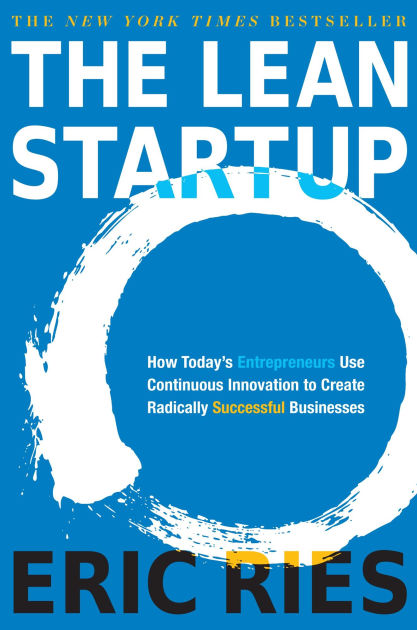
The Lean Startup: How Today’s Entrepreneurs Use Continuous Innovation to Create Radically Successful Businesses
Eric Ries’ The Lean Startup revolutionized the approach to building and scaling startups by introducing a systematic methodology for creating successful ventures in conditions of extreme uncertainty. Drawing from his own entrepreneurial experiences and combining principles from lean manufacturing and customer development, Ries provides a scientific approach to entrepreneurship that has influenced millions of entrepreneurs worldwide.
The Central Premise: Entrepreneurship in Uncertainty
Ries’ core argument is that traditional approaches to business planning and product development are inadequate for the uncertain environment of startups. Rather than spending months or years developing a detailed business plan, entrepreneurs should embrace uncertainty and use systematic experimentation to discover what customers actually want.
The book challenges the traditional assumption that successful entrepreneurship requires executing a predetermined plan. Instead, Ries argues that success comes from learning faster than competitors and adapting quickly to market feedback.
Part I: Vision
The Problem of Startup Failure
Ries begins by addressing the fundamental problem that plagues startups: the vast majority fail not because they can’t build products, but because they build products nobody wants. This insight shifts the focus from execution to validated learning.
The Lean Startup Method
The Lean Startup methodology combines principles from lean manufacturing (originally developed by Toyota) with customer development practices. It provides a framework for:
- Testing business hypotheses quickly and cheaply
- Iterating based on customer feedback
- Making data-driven decisions about whether to pivot or persevere
Entrepreneurial Management
Ries introduces the concept of entrepreneurial management - a new kind of management specifically designed for the uncertain conditions of startups. This approach emphasizes:
- Rapid experimentation
- Cross-functional teams
- Accountability based on learning rather than traditional metrics
Part II: Steer
Build-Measure-Learn Feedback Loop
The fundamental activity of a startup is to turn ideas into products, measure how customers respond, and then learn whether to pivot or persevere. This continuous feedback loop is the engine of the Lean Startup methodology.
Build
The Build phase involves creating a Minimum Viable Product (MVP) - the version of a new product which allows a team to collect the maximum amount of validated learning about customers with the least effort.
Measure
The Measure phase involves collecting data on how customers actually behave with the product, rather than relying on surveys or focus groups. Ries emphasizes the importance of actionable metrics over vanity metrics.
Learn
The Learn phase involves analyzing the data to determine whether the experiment validated or invalidated the startup’s hypotheses. This learning then informs the next iteration of the Build-Measure-Learn cycle.
Minimum Viable Product (MVP)
Ries explains how to create MVPs that test core assumptions with minimal resources. Examples include:
- Dropbox’s explainer video that validated demand before building the actual product
- Zappos’ founder who took photos of shoes in stores to test online demand
- IMVU’s simple 3D chat application that tested social networking concepts
Pivot or Persevere
Based on learning from experiments, startups must make the difficult decision to either pivot (change direction) or persevere (continue with the current strategy). Ries provides a framework for making these decisions based on data rather than emotion.
Part III: Accelerate
Scaling Innovation
Once a startup has found product-market fit, it must scale efficiently. Ries discusses how to apply Lean Startup principles to growth:
- Growth models and engines
- Innovation accounting for measuring progress
- Organizational design for scaling
Innovation Accounting
Traditional accounting methods don’t work for startups due to their high uncertainty and lack of proven business models. Innovation accounting provides a way to measure progress in startups using:
- Actionable metrics that demonstrate cause and effect
- Accessible metrics that can be understood by all team members
- Auditable metrics that can be verified by external parties
Growth Engines
Ries identifies three primary growth engines that drive successful startups:
- Sticky Engine - Focus on retaining existing customers
- Viral Engine - Focus on customers bringing in new customers
- Paid Engine - Focus on acquiring customers through paid channels
Key Concepts and Principles
Validated Learning
Rather than making assumptions about what customers want, startups should test their hypotheses with real customers as quickly as possible. This approach emphasizes learning over execution.
Scientific Method in Business
Ries introduces the scientific method to business, encouraging entrepreneurs to:
- Form hypotheses about customer needs and behavior
- Conduct experiments to test these hypotheses
- Draw conclusions based on evidence rather than assumptions
Customer Development
The Lean Startup methodology emphasizes understanding customer problems and needs before building solutions. This approach fundamentally shifts the focus from what entrepreneurs think customers want to what customers actually need.
Batch Size and Flow
Drawing from lean manufacturing principles, Ries discusses how reducing batch sizes (the amount of work done before getting feedback) can accelerate learning and reduce waste.
Practical Applications
For Entrepreneurs
- Start with an MVP to test core assumptions
- Focus on validated learning rather than building features
- Make data-driven decisions about pivoting or persevering
- Use innovation accounting to measure progress
For Established Companies
- Create internal startup-like environments
- Encourage experimentation and learning
- Apply Lean Startup principles to new product development
- Build innovation accounting systems
For Investors
- Look for startups that understand validated learning
- Evaluate teams based on their ability to pivot
- Focus on learning velocity rather than execution speed
- Use innovation accounting to assess portfolio companies
The Impact of “The Lean Startup”
Since its publication in 2011, The Lean Startup has had a profound impact:
- It became a bestseller and was translated into over 30 languages
- It influenced how venture capitalists evaluate startups
- It led to the creation of Lean Startup conferences and communities worldwide
- It changed how entrepreneurship is taught in universities and business schools
Criticisms and Considerations
While widely praised, Ries’ approach has faced some criticism:
- Some argue that the methodology works better for software startups than physical products
- Others question whether the approach applies equally to all industries
- The emphasis on pivoting may lead to abandoning potentially successful ideas too quickly
Conclusion
The Lean Startup provides a powerful framework for navigating the uncertainty that characterizes entrepreneurial ventures. Ries’ insights help readers:
- Understand that startup failure often stems from building products nobody wants
- Apply the Build-Measure-Learn feedback loop to test assumptions quickly
- Create MVPs that validate core hypotheses with minimal resources
- Make data-driven decisions about whether to pivot or persevere
- Use innovation accounting to measure progress meaningfully
The book’s enduring popularity reflects a widespread need for systematic approaches to entrepreneurship in an age of rapid change and uncertainty. Ries’ combination of personal experience, theoretical frameworks, and practical examples makes complex concepts accessible and actionable.
Whether you’re launching a new venture, working within an established company seeking to innovate, or investing in startups, The Lean Startup provides valuable tools for creating successful businesses in today’s dynamic environment.
Ries’ central message is empowering: success in entrepreneurship is not about having the perfect idea or executing flawlessly, but about learning faster than competitors and adapting quickly to market feedback. By embracing uncertainty and using systematic experimentation, entrepreneurs can significantly increase their chances of building successful ventures.
The book ultimately encourages readers to stop waiting for perfect conditions or complete certainty and start experimenting now, with whatever resources and circumstances they have. It’s a call to action that recognizes the reality of entrepreneurial uncertainty while providing a clear path forward.