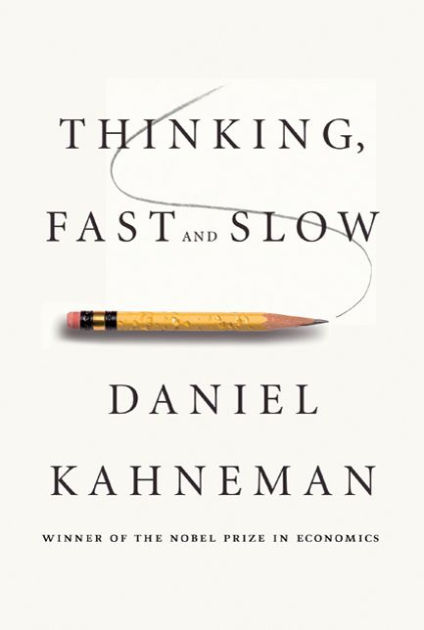
Thinking, Fast and Slow
Thinking, Fast and Slow is a landmark book by Nobel Prize winner Daniel Kahneman that revolutionizes our understanding of human thought processes. Drawing on decades of research in psychology and behavioral economics, Kahneman introduces a groundbreaking model of the mind that distinguishes between two systems of thinking, each with its own capabilities and limitations.
The Two Systems of Thinking
System 1: Fast Thinking
System 1 operates automatically and quickly, with little or no effort and no sense of voluntary control. It includes:
- Expert intuitions
- Impulses
- Emotions
- Detecting that one object is more distant than another
- Orienting to sounds
- Completing the phrase “bread and…”
System 2: Slow Thinking
System 2 allocates attention to effortful mental activities that demand it, including computations. The operations of System 2 are often associated with the subjective experience of agency, choice, and concentration. It includes:
- Complex calculations
- Logical reasoning
- Deliberate choices
- Focusing attention on specific tasks
- Overriding intuitive responses
Key Concepts and Insights
Cognitive Biases
Kahneman demonstrates how System 1, despite its remarkable efficiency, is prone to systematic errors that can lead to poor judgments:
Anchoring Effect
People tend to consider a particular value for an unknown quantity before estimating that quantity. The final estimate stays close to the initial value, or “anchor.”
Availability Heuristic
People judge the probability of events by how easily examples come to mind. This can lead to overestimating the likelihood of dramatic or memorable events.
Representativeness Heuristic
People judge the probability that an object or event belongs to a class or process based on how similar it is to a typical case, often ignoring relevant base rates.
Prospect Theory
Building on his Nobel Prize-winning work with Amos Tversky, Kahneman explains how people make decisions under risk:
- People are more sensitive to losses than to gains (loss aversion)
- People evaluate outcomes relative to a reference point
- People overweight small probabilities and underweight large probabilities
The Law of Small Numbers
People have a tendency to believe that small samples closely resemble the population from which they are drawn, leading to overinterpretation of random events.
Practical Applications
Decision Making
Kahneman provides insights into how to make better decisions by:
- Recognizing when to override intuitive judgments
- Understanding the role of emotions in decision-making
- Using checklists and systematic approaches for complex decisions
Risk Assessment
The book offers guidance on evaluating risks more accurately by:
- Considering base rates
- Avoiding the availability heuristic
- Understanding the difference between risk and uncertainty
Organizational Behavior
Kahneman discusses how organizations can improve decision-making processes:
- Reducing bias in hiring and promotion decisions
- Improving forecasting methods
- Creating systems that compensate for cognitive limitations
The Psychology of Choices
Framing Effects
The way information is presented can significantly influence decisions, even when the underlying facts remain unchanged.
Mental Accounting
People think of their money in categories, treating money differently depending on its source or intended use, which can lead to irrational financial decisions.
The Endowment Effect
People ascribe more value to things merely because they own them.
The Experiencing Self vs. The Remembering Self
Kahneman introduces a distinction between two aspects of the self:
- The experiencing self lives through events moment by moment
- The remembering self constructs stories and makes decisions based on memories
This distinction has profound implications for how we evaluate our lives and make choices about our future.
Overconfidence and Intuition
The book explores the limits of expert intuition and the conditions under which expert judgments can be trusted. Kahneman explains:
- When intuitive expertise can be trusted
- The role of feedback in developing expertise
- The dangers of overconfidence in professional settings
The Fourfold Pattern
Kahneman presents a framework for understanding how people make decisions under risk based on two dimensions:
- Probability (high vs. low)
- Outcome (gains vs. losses)
This pattern helps explain seemingly contradictory behaviors in decision-making.
Hindsight Bias and the Illusion of Understanding
People tend to believe, after an event has occurred, that they would have predicted or expected the outcome. This bias leads to an overconfidence in our understanding of the world.
The Role of Emotions
Kahneman discusses how emotions influence judgment and decision-making:
- The affect heuristic: People let their likes and dislikes determine their beliefs
- The role of fear and anxiety in risk perception
- How mood affects cognitive performance
Practical Advice for Better Thinking
Recognizing Bias
- Understanding common cognitive biases
- Creating systems to catch errors in judgment
- Seeking out disconfirming evidence
Improving Judgment
- Slowing down when stakes are high
- Using statistical thinking
- Seeking diverse perspectives
Organizational Applications
- Designing better processes for group decision-making
- Reducing bias in performance evaluations
- Creating cultures that encourage critical thinking
The Science Behind the Insights
Throughout the book, Kahneman provides detailed explanations of the experimental methods used to uncover these insights, making the science accessible to general readers while maintaining academic rigor.
Criticisms and Limitations
Kahneman acknowledges that his model is not without limitations:
- The boundaries between System 1 and System 2 are not always clear
- People can sometimes train their intuitions to be more accurate
- Cultural differences in thinking patterns
Conclusion
Thinking, Fast and Slow is more than a book about psychology—it’s a guide to understanding how our minds work and how we can make better decisions. Kahneman’s insights have profound implications for individuals seeking to improve their judgment and for organizations striving to make better choices.
By understanding the strengths and limitations of both fast and slow thinking, readers can learn to:
- Recognize when their intuitions might be leading them astray
- Know when to engage in more deliberate analysis
- Create systems and processes that compensate for cognitive limitations
- Make better decisions in both personal and professional contexts
The book’s influence extends far beyond psychology, impacting fields such as economics, business, medicine, and public policy. It has fundamentally changed how we think about thinking itself, providing readers with the tools to understand their own minds and make better decisions in an increasingly complex world.